The 1% Rule: Why Trading Survival Starts With Knowing How Much You Can Lose
Most beginners enter the stock market with one question:
“How much can I make?”
A more important question comes first:
“How much can I afford to lose?”
That shift in thinking is at the heart of professional risk management. A trading strategy may identify an opportunity, but risk management determines how much capital is exposed when the trade goes wrong.
For anyone learning stock market trading in Nagpur or elsewhere, understanding this difference can completely change the way trading is approached.
The 1% Rule Explained
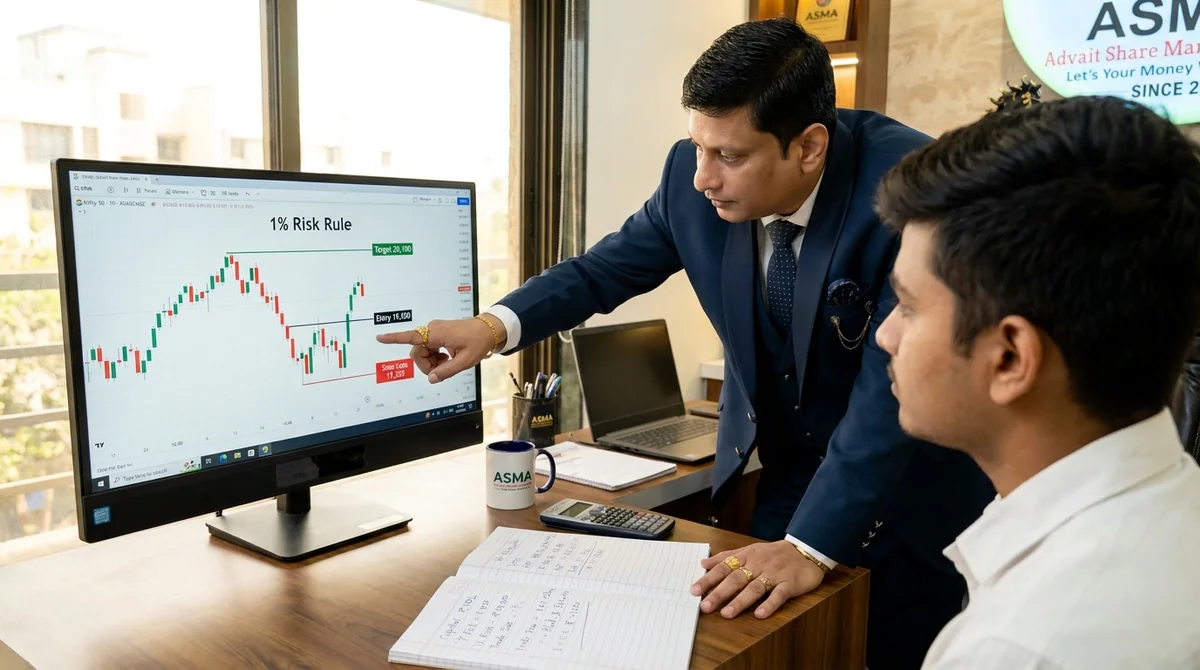
One risk-management principle taught at Advait Stock Market Academy (ASMA) is the 1% Risk Rule: do not risk more than 1% of total trading capital on a single trade. ASMA combines this with hard stop losses, position sizing and defined risk-to-reward parameters.
Consider a simple example. Suppose your trading capital is ₹1,00,000.
Under a 1% risk limit: Maximum planned loss = ₹1,000.
If your stop-loss distance is ₹10 per share, your position size would be: ₹1,000 ÷ ₹10 = 100 shares.
The important point is that position size is determined by risk, not by how much money you happen to have available for a larger trade.
Why Stop Loss Alone Is Not Enough
A stop loss defines where a trade is considered invalid. But before entering, a trader should also know the potential reward relative to that risk.
ASMA's framework uses a minimum 1:2 risk-to-reward ratio.
In the example above:
- Risk = ₹1,000
- Potential target at 1:2 = ₹2,000
This does not guarantee that the target will be reached. It simply creates a predefined framework for evaluating a trade.
This distinction matters because a strategy does not need to win every trade to have positive mathematical expectancy. What matters is how wins, losses and risk are managed over a series of trades—not the outcome of one individual position.
The Reality Behind F&O Trading
This discipline becomes particularly important in derivatives.
SEBI's latest study, released in August 2026, found that 87.7% of individual traders in equity derivatives incurred losses during FY26, with aggregate net losses of about ₹91,685 crore. The study also found that individual participation declined during the year.
SEBI's investor education material explains why derivatives require particular caution: their relatively small upfront amount compared with the underlying can multiply both profits and losses.
The lesson is not that derivatives should automatically be avoided. It is that leverage makes risk discipline more important, not less.
Trading Is a Probability Game, Not a Prediction Game
No strategy can know with certainty what the next candle will do.
A disciplined trader therefore does not need to be right every time. Instead, the focus is on defining: Entry → Risk → Stop Loss → Position Size → Target → Exit Rule
ASMA's curriculum places risk management alongside technical analysis and market psychology because a trading setup and the trader's behaviour are connected.
That is why learning trading is not simply about finding more indicators.
It is about building a process that still makes sense when a trade goes against you.
The Real Goal: Stay in the Game
Markets will produce winning trades and losing trades.
The objective of risk management is to ensure that one mistake—or even a series of mistakes—does not destroy the capital required to continue learning and trading.
That is the deeper idea behind the 1% Rule:
“You cannot control what the market will do. You can control how much you expose when you are wrong.”
For beginners searching for stock market training in Nagpur, learning this principle early can be more valuable than memorising dozens of trading setups.
Because sustainable trading begins not with the question “How much can I make?”
It begins with: “How well can I manage the downside?”
Related Articles
Education First, Predictions Never: The ASMA Philosophy
Most people's introduction to the stock market is a tip. By the time they ask to be taught properly, they've usually lost money. Discover why ASMA focuses on education over shortcuts.

Why Live Market Training Matters for Stock Market Beginners in Nagpur
Discover why live-market training matters for beginners and how practical education, risk management and trading psychology can improve stock market learning in Nagpur.
How to Start Learning the Stock Market in Nagpur: A Beginner’s Roadmap
Learn how to start your stock market journey in Nagpur with a structured roadmap covering market basics, technical analysis, risk management and practical training.
Continue Learning with ASMA.
Explore practical stock market training programs designed to build market understanding.